


For subscription-based businesses, renewals are critical to survival. Yet despite your team’s best efforts, hitting retention targets can feel unpredictable. Forecasts look reliable until the numbers come in short, leaving everyone looking for answers.
But what if the problem isn’t your team or your customers, but the structure behind your renewal forecasts?
This article explores why renewal forecasts frequently miss the mark, why relying on gut feelings leads to inconsistency, and how introducing clear, structured renewal criteria changes everything.
With the right approach, your renewal forecasts won’t just become more accurate, they’ll become a genuine tool for growing your business.
Do You Trust Every Renewal Forecast?
You run the renewal forecast review with everyone on the call. The agenda is ready, numbers look clean, and deal by deal, the team weighs in.
“This one’s solid.”
“We’ve got a good relationship with them”
“I’m confident they will renew.”
And for the most part, you believe them.
But then the quarter closes, and a few of those confident renewals don’t land. One churns unexpectedly, and another “pushes” their decision back into the next quarter, though no one mentioned any risk. There were no warning signs but the forecast was off, again.
We believe that there’s a better way, a way you can spot this risk.
It’s not that your team isn’t engaged, it’s that they’re reading different signals, through different filters, with no shared standard for what “safe” actually means. One person might be focused on usage data, another on sentiment from recent calls. Someone else is thinking about stakeholder behaviour or billing friction. All of them are offering a view, but they’re not looking at the same thing.
So while the forecast looks aligned on the surface, it’s stitched together from conflicting interpretations. It’s not malicious or careless, just inconsistent. And because the inputs aren’t structured, the outputs can’t be trusted.
Without a defined process for how renewal risk is assessed, there’s no way to know whether confidence is grounded in something real, or just habit. You can’t coach against it and you can’t improve it. You can’t really spot patterns either.
When everyone’s relying on their own judgement, you don’t get a forecast. You get a patchwork of educated guesses. That’s the real reason you’re missing your numbers, not because your team is wrong, but because your system doesn’t give them a way to be right together.
Why This Keeps Happening
Teams don’t default to gut feelings because they’re lazy or careless; usually, it’s exactly the opposite. They rely on instinct because they’re busy, under pressure, and often dealing with limited data. In the absence of clear criteria for evaluating renewal health, relationship quality becomes the fallback. It feels safe, especially when the signals are subtle and the warning signs ambiguous.
But there’s a subtle problem here. Relationship strength, sentiment, and gut checks aren’t inherently wrong. After all, successful renewals do often hinge on the human relationships your teams build. But without a consistent set of standards across the entire team, even well-intentioned judgment calls start to diverge. “Good relationship” means one thing to your most optimistic account manager and something entirely different to your cautious head of customer success.
That’s why one rep might confidently call a renewal solid while another, looking at similar signals, sees potential risk. Each person’s definition of a safe renewal ends up shaped by their personal experiences, biases, and even the kind of day they’re having. Without an explicit, structured set of criteria, every forecast essentially becomes subjective. It’s consensus without consistency.
And when forecasts become subjective, the natural incentive is optimism. Account managers don’t like flagging risk unnecessarily. Customer Success managers believe in their teams’ ability to turn sentiment around. Everyone wants to project confidence and that’s understandable. But the problem is that subjective optimism can disguise genuine risk, right up until the moment the renewal slips.
This isn’t about assigning blame; it’s about recognizing a quiet but persistent gap. Unless you create a structured way to align these judgments across the team, forecasts will remain fuzzy and unreliable, no matter how skilled or experienced the individuals involved might be.
The Cost of Inconsistency
Your reps genuinely want to believe renewals are safe and that optimism isn’t inherently a bad thing. It’s partly why they’re successful in sales or customer success in the first place: they build strong relationships and trust their intuition. But optimism without structure creates blind spots, and that’s where problems can grow.
Renewals can easily become second-tier priorities, especially when new business targets dominate attention. Account managers find themselves stretched between onboarding new customers and chasing renewals, often prioritising whatever feels more urgent. Renewals, assumed safe until proven otherwise, can slip into the background. And the more confident your team feels about a renewal, the less likely they are to notice subtle shifts in customer behaviour or usage patterns that could signal real trouble.
Managers, meanwhile, don’t spot these subtle signals until it’s too late. Without clear, structured renewal criteria to review regularly, they have little choice but to trust their teams’ gut feelings. But as we’ve discussed, this can keep risk hidden until it suddenly materialises. Leadership is caught off guard, quarter after quarter, scrambling to understand why “safe” renewals have churned, forecasts have skewed, and retention targets have slipped again.
The real cost isn’t just the missed forecasts, it’s the persistent unpredictability that follows. Without consistency, every quarter feels reactive rather than proactive, forcing leadership to rely on constant firefighting, and chasing new business instead of strategic renewal planning.
The Value Of A Structured Approach
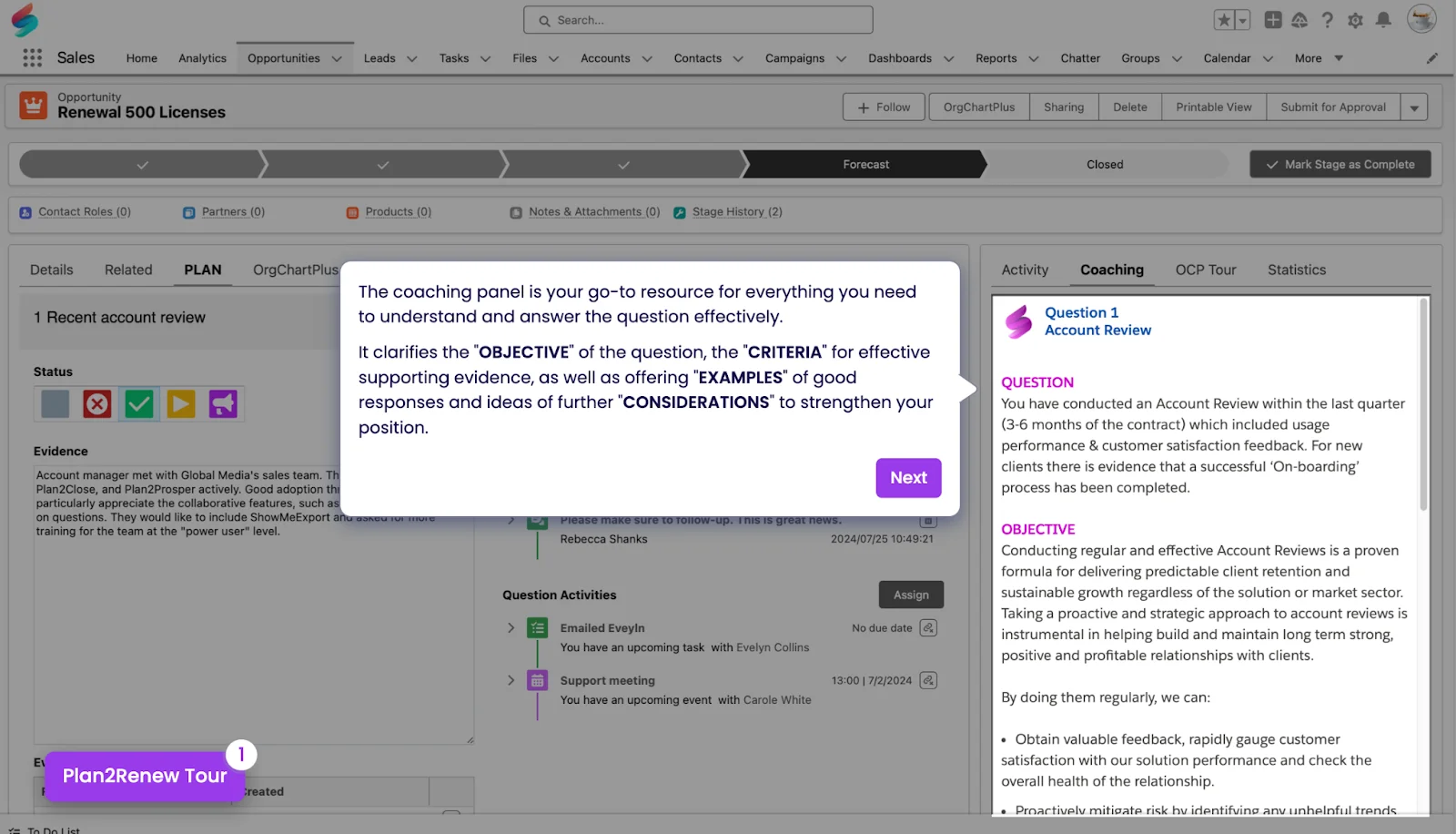
If inconsistent forecasting is the problem, structure is your solution. But let’s clarify something important: structure doesn’t mean bureaucracy. It doesn’t mean slowing your team down with unnecessary checklists or forcing them through rigid steps that don’t fit your business. It simply means aligning everyone around a clear, shared standard of what renewal health actually looks like.
That’s exactly what Plan2Renew (P2R) provides. Instead of leaving reps and account managers to interpret renewal risk on their own, P2R builds consistent renewal hygiene right into your Salesforce org. Every time your reps assess renewal likelihood, they’re guided by clear questions (that you can choose) designed to surface subtle signals of risk early, when there’s still plenty of time to respond.
Importantly, this isn’t generic “best practice” guidance. Each question prompts your reps to back up their judgement with actual evidence that you can view and coach on. So instead of relying solely on relationship feel or intuition, your team now uses consistent, data-driven criteria. This makes renewal forecasts not just defensible, but genuinely trustworthy.
Best of all, Plan2Renew isn’t rigid. Your sales ops or revenue leaders can customise these structured renewal flows, focusing precisely on the factors that matter most in your unique context. Whether executive engagement is critical, or product adoption, or procurement timelines – your process can evolve as your business does, making your renewal forecasts both precise and relevant.
You’re left with renewal forecasts that are no longer educated guesses, but clear, measurable insights you can use not just to forecast renewals accurately, but to actively increase your renewal rate.
Turning Risk Into Visibility (and Visibility Into Action)
Like we’ve discussed, every business defines renewal risk differently. For some, risk surfaces early when executive stakeholders disengage. For others, it’s usage patterns that quietly decline. It might be something as practical as procurement red flags or bottlenecks in contract discussions. What matters is not which of these you track, but that everyone tracks the same things in the same way.
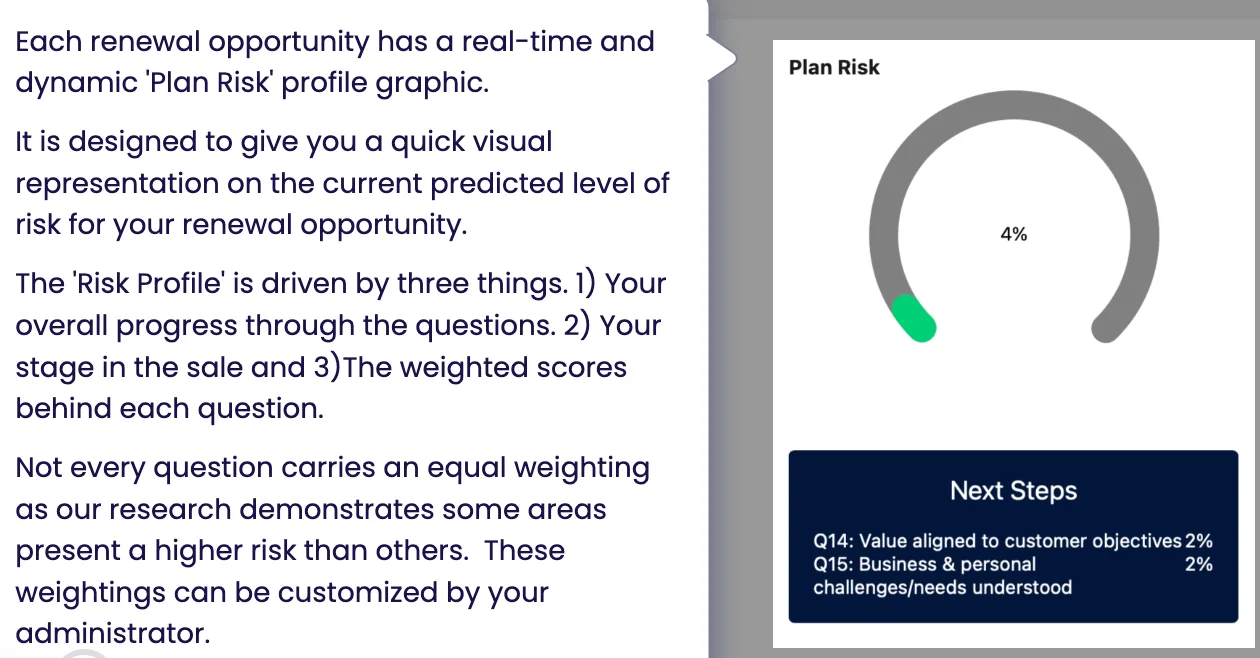
That’s where Plan2Renew’s custom risk scoring comes in. Rather than forcing your team into a one-size-fits-all approach, it lets you build your own scoring system, aligned to the exact signals that matter most to your renewals. Each renewal gets a clear, structured score that makes risk tangible.
The immediate advantage is clear visibility: leaders can glance at the pipeline and instantly spot renewals that are genuinely on track versus those slipping quietly into risk territory. But the deeper benefit is that visibility creates accountability, which then becomes the basis for meaningful coaching. Instead of vague conversations (“This renewal seems shaky”), managers can now zero in on specific, documented signals (“Executive engagement is dropping; let’s prioritize a check-in with their leadership”).
And as your business evolves, your scoring criteria can evolve too. Plan2Renew isn’t a static solution; it’s built to adapt as you spot patterns, refine your understanding of renewal risk, and deepen your coaching conversations. Renewal forecasts stop being guesses and become precise indicators, helping your entire organisation not just predict retention, but actively drive it.
Summary
Renewals are too important to leave to guesses. Yet without structure, even your best reps are forced to rely on intuition and inconsistent signals. The cost of these inaccuracies is high: missed targets, reactive quarters, and limited visibility into real renewal health.
Plan2Renew offers a structured, Salesforce-native solution that brings structure to your renewals. By guiding reps through consistent, evidence-based assessments and allowing you to customise risk scoring, it moves renewal forecasting from subjective optimism to measurable accuracy.
Explore the Plan2Renew interactive demo to see structured renewal planning in action.