
How to Manage Sales Team Turnover Without Losing Revenue
- Posted 10/2025
- Blogs
Most sales leaders’ conversations revolve around quota and pipeline, but far fewer ask a more fragile question: how long do we actually get to keep the people our customers rely on? Every customer conversation your salespeople have is part of an asset that, if you’re not careful, can walk out the door.
The clock on your new hires sales tenure starts ticking from day one.
Industry numbers make the risk clear. HubSpot puts average salesperson tenure at just 18 months and The Bridge Group’s data shows it takes around 3 months before they’re fully productive. This leaves barely over a year of high-output selling before the odds show you’ll be planning another transition. And the intent to churn is visible: with only 23% of salespeople anticipating working at their current company for just the next 3-6 months
Of course, not everyone fits the average. Some salespeople will stay longer when there’s growth ahead of them, others move quicker when there isn’t. But averages create risk, and these numbers are uncomfortable: salespeople are leaving companies fast, and taking customer knowledge with them.
In this article, we’ll take a look at the impact of turnover on your customers, and the practices you can implement that keep revenue and relationships intact when salespeople move on.
The Impact of Salesperson Turnover on Customer Relationships
Knowing that salespeople move on quickly is only the first part of the story. The question we want to explore now is: How does this impact your customer relationships?
Every transition leaves a mark. These aren’t always visible in a forecast report, but they’ll be obvious to your customers. By the time any issues show up in your data, you’ll already be suffering from slower deals or missed renewals.
In practice, three breakdowns recur every cycle: customer knowledge vanishes, trust erodes, and sales performance dips. Customer knowledge vanishing and trust eroding are directly connected, but we’ll take these one at a time, so you can see why turnover is a customer-continuity problem that compounds if history isn’t captured.
Loss of Customer Knowledge
Salespeople carry the customer’s memory. Over months or years, they learn the preferences that do not make it into CRM: which product configurations the client prefers, which features they rely on, how billing needs to be structured for finance to sign off. They also hold the subtler pieces like who really influences a decision, or which competitor is always in the background trying to poach them. This is the “institutional knowledge” that makes service feel personal, and allows great relationships to be created.
When the salesperson leaves, that memory often leaves with them. What’s left in the system (account name, deal value, last activity date) is too thin to maintain continuity. The new hire comes in missing the texture of the relationship, so conversations feel generic and service feels disrupted. Customers notice. It’s easy to hide behind your CRM data, thinking that it is ‘good enough’, yet 44% of respondents estimate their company loses over 10% in annual revenue due to poor quality CRM data, while Gartner puts the wider cost of bad data at $12.9 million a year. In other words: every departure risks both vacancy on your sales team, and a hole in the customer’s experience that bleeds revenue.
Disrupted Client Trust
When a familiar salesperson leaves, customers often lose the rhythm they had with someone who knew their priorities and shortcuts. As we discussed, the new salesperson arrives with a lack of detail, they might ask for a “get-to-know-you” call, yet they’re unable to reference the important details and history that the previous salesperson spent time gathering.
The institutional knowledge we mentioned left with the previous salesperson. Now, the customer is repeating information they expected their vendor to already know. Research shows how high the stakes are, with 71% of customers expecting internal teams to collaborate so they don’t have to repeat themselves, and 70% of customers say connected processes such as seamless handoffs or contextualized engagement based on earlier interactions are very important to winning their business.
When those expectations aren’t met, trust erodes fast. Even loyal customers have limits with 32% of all customers saying they would stop doing business with a brand they loved after one bad experience. That “bad experience” can be as simple as a clumsy handoff: a company that forgets their history, makes them restate needs, and signals instability.
Once doubt takes root, loyalty softens and the competitor that is always in their ear suddenly looks more appealing.
Short-Term Sales Performance Dip
Sales performance takes a measurable hit during a transition. We showed earlier that it takes three months for a salesperson to get up to speed. This is where late-stage opportunities risk stalling and renewals slip because the salesperson hasn’t yet earned the confidence to push them through.
Forecast accuracy erodes in parallel as deals marked “commit” keep sliding into the next quarter. While this is happening, managers often pile extra accounts onto experienced salespeople to compensate, which dilutes their focus. The macro picture is worse when you consider HubSpot’s reports that the average salesperson turnover is 35 percent, which is higher than the average for all other industries at 13 percent. SiriusDecisions data also shows that almost half (45 percent) of B2B sales organizations have average turnover rates above 30 percent. Combine the churn rate with the long ramp, and you see the systemic drag: every cycle of departures and hires cuts months of selling capacity out of the year. What looks like isolated underperformance is in fact a predictable cost of turnover.
Best Practice for Managing Sales Team Turnover
Checklists, CRM hygiene, and a culture of shared notes all help with these problems, but they rely heavily on discipline. One missed update, one salesperson who retains information offline and undocumented, and the cycle starts again. So rather than focusing on what should salespeople do? Let’s explore how you provide them with a process & connected system that makes it natural to do it right, every time.
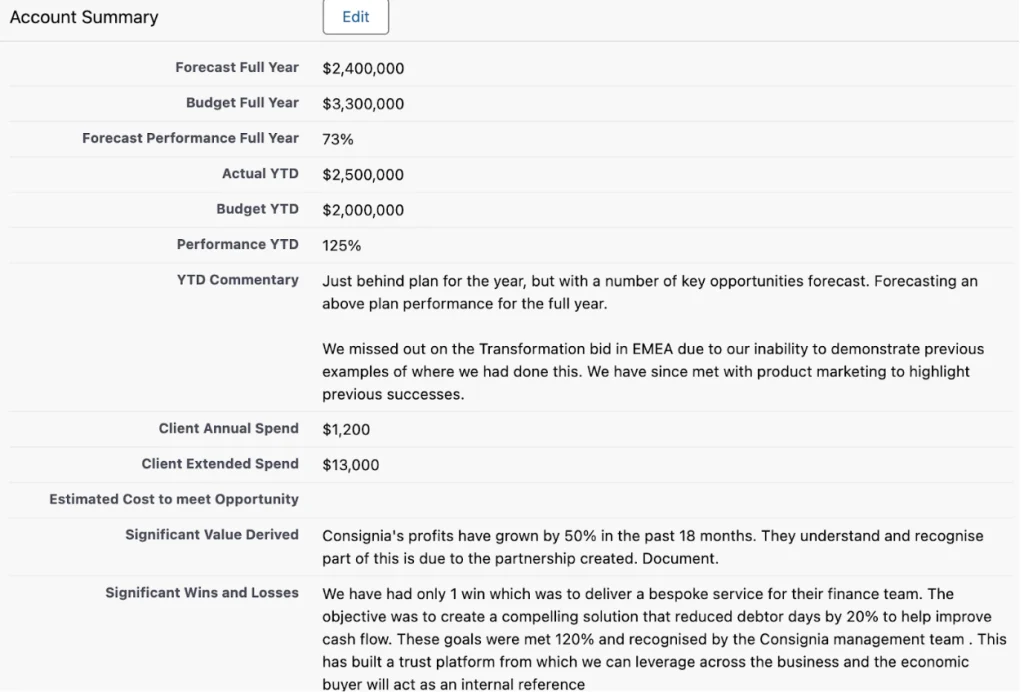
That’s the role of a capability such as Plan2Prosper. It takes the ideal habits we’ll discuss below and anchors them inside Salesforce by connecting a comprehensive plan to each account. Instead of hoping handover details make it into the right document, crucial details are recorded by habit inside Salesforce. Account information becomes a company asset. Instead of relying on memory, key account data history like relationship status or service history is structured and accessible. And because it’s native to Salesforce, both managers and salespeople see the same picture without extra effort.
Smooth Transition Planning
A useful handover needs the practical context: something as simple as which executive assistant is blocking diary time will help new salespeople. Without that level of detail, even healthy deals can stall. Customers get frustrated repeating themselves, and the company ends up footing the bill in the form of delayed revenue. Smooth transition planning keeps momentum alive: deals keep moving, renewals don’t slide, and customers see continuity instead of disruption.
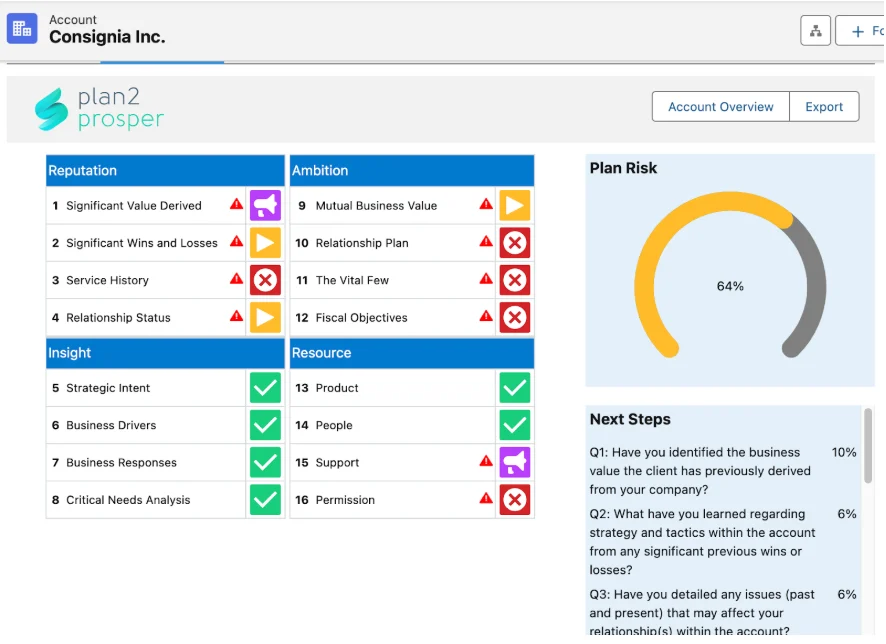
With Plan2Prosper, this kind of detail is recorded with ease. This means the next salesperson can step into a deal with the detail they need to create a smooth process. Below you can see an example of just one question in the Plan2Prosper account plan. This is all information that a new hire wouldn’t be able to access without Plan2Prosper. Now, they have identified a specific contact to build a relationship with (William Hague, Corporate VP & GM EMEA) and a goal to be included in their annual ‘Blue Sky’ event too.

CRM as the Continuity Engine
A CRM filled with account names and stages isn’t much help in a handover. What makes it a real continuity engine is whether the substance of the relationship lives there too – why a decision was delayed, what pricing conversations have already been shut down, which competitor always pops up in meetings, even which stakeholder refuses to answer email but replies instantly on WhatsApp. When those details are captured, a new salesperson can step in without asking the customer to rehash their history. That saves time and protects trust. Customers feel like their Vendor – now “Trusted Partner” has been paying attention all along, instead of starting over from scratch. For the sales team, it shortens ramp time and keeps forecasts reliable.
Plan2Prosper provides your team with an easy-to-use platform to store this important detail. To help with the continuity, the new hire will be able to access the live plan risk donuts for all of their accounts. On top of this, they’ll have clear next steps already outlined to hit the ground running.

Make Customer Knowledge a Shared Asset
The only way to stop the cycle of customer history walking out the door is to treat knowledge as a shared company asset. Every note about stakeholder influence, every update on budget cycles, every signal of a competitor in the background needs to be captured and visible. That way, the next salesperson doesn’t inherit just a list of contacts, but useful details of the account’s politics and priorities.
Plan2Prosper builds this directly into Salesforce, turning this data into a durable record. However, it isn’t enough to just provide somewhere for the salesperson to record the data, it must be easily accessible and structured for a new hire to understand, and that’s exactly what you can provide with Plan2Prosper. The benefits are fewer “reset” conversations, faster recognition of risks, and customer relationships that belong to the business, not the individual salesperson.
Key Takeaway for Sales Leaders
Salespeople leave faster than companies usually plan for, and the real cost is the customer knowledge that disappears with them. If you don’t have a way to capture and share that knowledge, every transition resets trust, stalls deals, and eats into your forecast.
The companies that ride out turnover without losing momentum are the ones that treat account knowledge as a shared asset. They don’t leave it to discipline or memory; they build systems that make capturing detail the default. That’s what Plan2Prosper does inside Salesforce: it makes every conversation, every relationship, and every deal insight part of the company record.
For sales leaders, the decision is straightforward: do you want each salesperson’s departure to mean months of lost productivity and customer doubt, or do you want continuity that outlives any one salesperson? The tools exist to make the latter your norm.Take a 5 minute virtual tour here.