Can The MEDDPICC® Sales Methodology Help Your BDRs Qualify Better?
- By SalesMethods
- Posted 11/2025
- Blogs
Ask any sales team to define what “qualified” means and you’ll get different answers, each shaped by the pressures of their role. For one BDR, it’s a meeting booked. Whereas another might have their own ‘intent signal’ in their head. Your AEs may value different things like a confirmed budget or decision structure. For a manager, it could just be anything that fills the pipeline enough to sustain the forecast.
Now, some might argue that salespeople don’t care about quality. We’re not here to blame you or your team, we’re here to offer a solution. We think the systems and metrics that reward activity more than evidence are to blame. Every week, deals are passed from one person to the next with the right boxes ticked but the wrong information is captured. Notes are incomplete while Salesforce fields are vague, and everyone trusts that someone else has verified the important details. AEs show up to calls still uncovering basic facts like what’s driving the purchase, while sales leaders are in the dark as their dashboards continue to be green.
This misalignment turns your pipeline into a hall of mirrors: it reflects activity rather than reality. Over time, that distortion breaks trust and alignment between teams, it leads to wasted hours on conversations that should never have left discovery, and makes your forecasting inaccurate. When “qualified” just means “booked,” you’re tricking yourself into thinking you’re making progress and killing your conversion rates at the same time.
Are Bad Deals Filling Your Pipeline?
Every sales team will have their own qualification process. It’s always going to be different depending on your industry, average deal size, sales setup etc. Again, we’re not here to blame your team and say that they’re bad at qualifying. We think it’s because your system can’t distinguish evidence from optimism.
Salesforce captures fields, stages, and activity data, but none of these alone confirm that a deal is genuinely advancing, or that the account is a suitable prospect. A poorly qualified meeting booked looks identical to a verified buying conversation. Over time, this creates a feedback loop where quantity pretends to be quality. When the forecast is inaccurate and deal closure rates are lower than expected, the instinct is to double down on coaching. Maybe you need new templates, or better scripts, when what we think would work better is a shared definition of proof that everyone can see and trust.
The heart of the issue is that the idea of a “good” qualification lives in people’s heads, not Salesforce itself. Like we said, each salesperson develops their own idea: some mark ‘budget confirmed’ after a rough estimate, others wait for confirmed numbers. The CRM accepts both as valid, because it isn’t built to evaluate context, only completion. The result is predictable, your data feels clean but behaves inconsistently; reports look strong until they’re tested against revenue. Without a structure that forces clarity, one that embeds methodology directly into the workflow, teams can’t calibrate what quality actually means.
Using MEDDPICC® Sales Process To Improve Deal Qualification
Picture two BDRs on the same team. Both reach the same kind of prospect, both uncover pain points and successfully book a meeting. A week later, one AE walks into a call fully briefed on the customer’s initiative, budget owner, and success metrics. The other spends half the meeting discovering that the “problem” was a minor annoyance with no budget behind it.
What do you think the difference is? We think it’s structure, not talent.
A qualification methodology can guide your sales team and actively teach them how to qualify better, while still using their own techniques to get this information. MEDDPICC®, SPIN, or your home-grown process can be used to turn sales conversations into common, useful evidence.
You might have already trained and implemented a framework that hasn’t helped. The problem is that these frameworks die out quickly when they aren’t a part of your team’s workflow. You can keep them alive by making them native to the workflow. For example, a tool like Plan2Close embeds methodology inside your Salesforce org. It doesn’t ask reps to remember last year’s theory; it guides them through it and prompts them to prove it. When a BDR records a “pain,” they now define it in terms of measurable impact. When they note “decision process,” they can be asked who owns the outcome and what approval path exists. The CRM stops being a static checklist and becomes an instrument of critical thinking.
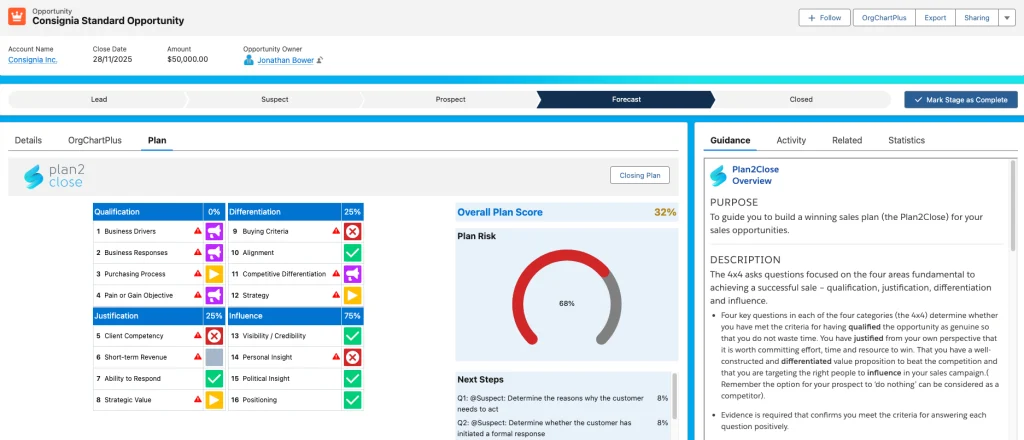
By bringing your qualification framework into Salesforce, AEs will stop opening calls by re-qualifying. Managers stop guessing at deal health and BDRs start to see patterns in the kind of deals that actually close. Qualification becomes less about your team’s personality, more about pattern recognition – the very thing a good methodology is meant to teach.
The Impact of Better Deal Qualification
The first thing leaders will notice isn’t more meetings, it’s fewer. Deals will only progress with context that holds up. Meetings that do happen are cleaner. Essentially, the pipeline thins, but conversion improves. Forecast accuracy increases because the early-stage data is more trustworthy and comprehensive. It’s not that reps became better guessers, it’s that “qualified” now means the same thing to everyone, and the system enforces that standard automatically.
Coaching becomes economical. Managers don’t need to sample dozens of calls to diagnose what’s wrong; they can filter for deals missing verified budget or decision authority and start there. Each session produces tangible change, because the gap is obvious, not emotional or anecdotal.
Across the team, energy will redistribute. BDRs no longer waste time chasing names that were never real prospects. AEs focus on opportunities that already have internal traction.
Summary
Plan2Close doesn’t claim to make people better sellers. It just makes the truth easier to see.
And when the truth is visible, everything else becomes easier to fix: coaching, enablement, even morale. The value isn’t just in better data; it’s in the confidence that comes from knowing your pipeline reflects reality.
That’s what better qualification really delivers, a team that finally trusts what it sees.
We’ve put together a virtual guided tour, so you can see how it works here.
MEDDPICC® version also available here.
If you have any questions, don’t hesitate to get in touch!
MEDDPICC® is a registered Trademark of Darius Lahoutifard, founder of MEDDIC Academy, where MEDDPICC® courses can be taken.
ABOUT THE AUTHOR