Artificial Intelligence VS Human Intelligence: How Should We Be Using AI in Sales?
- Posted 11/2025
- Blogs
In every conversation between a seller and a buyer, two kinds of intelligence are at work.
One captures what was said while the other interprets what wasn’t said. The first can be automated, the second can’t.
AI is reshaping how sales teams operate. It can listen to our calls and analyze patterns in data. It also has the potential to flag risk long before a human could notice. It feels like good progress. But something else is happening underneath: as machines take over the mechanics of awareness, the discipline of human judgment will naturally fade. Teams will be able to grow faster, yet less perceptive. The data gets cleaner while instincts get duller.
This isn’t an argument against AI. It’s an argument for remembering its strengths and weaknesses while using AI in your sales process. The sales intelligence that wins complex deals isn’t computational, it’s relational. It’s the kind that understands why a “no” today might be a “maybe” next quarter, or why silence isn’t disinterest but internal turbulence.
The challenge now isn’t to compete with artificial intelligence, but to protect human intelligence.
To design systems that let it grow instead of disappear. The following sections explore what that looks like, where the line should be drawn, and how mapping stakeholder relationships make it possible to scale human understanding without diluting it.
The Difference Between AI and Humans in Sales
We talk about artificial intelligence as if it’s a parallel to our own. A faster, more efficient version of the human mind. But that comparison brings two completely different kinds of intelligence into one surface-level debate. When we do that, we lose sight of what actually makes us useful in a world that’s becoming more automated by the day.
Especially in sales, where the real work isn’t just making decisions, but sensing when and why to make them.
AI acts when it’s prompted. It lives between input and output, in a closed loop of processing. We, on the other hand, remember what came before, imagine what might come next, and change our judgment because of both. That ability to perceive time as something that flows, not as data points but as lived experience, is what shapes our sales intelligence. It’s how we form context, empathy, and instinct. Machines don’t have that dimension. They might reference time or store ‘memory’, but they cannot use it like we do.
This difference matters most in how we sell. Every salesperson carries a map of their relationships in their head. We connect moments that AI can only catalogue. That’s why, even with perfect data, a human can walk into a meeting and sense a hesitation that no AI model predicted.
So when we talk about “AI-powered selling,” we shouldn’t imagine a replacement. We should imagine alignment. AI should be used to accelerate, while we decide what’s worth accelerating.
Why Judgment Still Decides Deals
Automation has given sales an illusion of clarity. Every conversation is recorded, every click tracked, every forecast modelled. Leaders often believe that more data means more certainty. But as we’ve discussed, the kind of intelligence AI produces is descriptive, not interpretive. It can tell us what has happened with perfect precision, yet it has no understanding of what made those things happen.
A dashboard can show a buyer’s silence; it cannot piece together previous data to understand whether that silence signals a political reshuffle that changed your decision maker. That difference between information and interpretation is where human intelligence continues to matter in sales.
When sellers sense risk, they are not reacting to one datapoint but to a pattern recognised from memory. This temporal reasoning allows them to act in anticipation rather than response. Machines can process far more inputs, but without memory in the human sense they cannot weigh cause and consequence.
As automation expands, the risk is not that humans become slower but that they stop exercising that important judgment altogether. When every cue is machine-generated, the habit of reasoning which creates great salespeople begins to erode. A team that relies entirely on predictive scoring may hit short-term efficiency gains yet stop diagnosing the complex human motives that decide long-cycle enterprise deals.
The outcome looks like a win at first, but the organisation’s collective intelligence becomes shallower with each quarter. As we said, AI should therefore be positioned as an accelerant, not a replacement.
The Cost of Losing Context in Sales
When people talk about “knowledge loss” in sales, they usually mean data. Missing fields, unlogged calls, untracked activities. But the real loss is harder to measure, it’s the erosion of context. Every time someone leaves a company, gets promoted, or moves territories, the mental map that connected people goes with them. What’s left behind is technically complete: names, titles, etc. but the useful information that really makes a difference to complex deals is lost. When that happens at scale, each new salesperson starts from zero, rebuilding relationships the last one already understood, why not share the knowledge?
The more systems we build to save time, the more we risk removing the very context that helps salespeople make good use of that time. In complex sales environments, relational memory is so important, as is the ability to recognise familiar dynamics before they become visible in data.
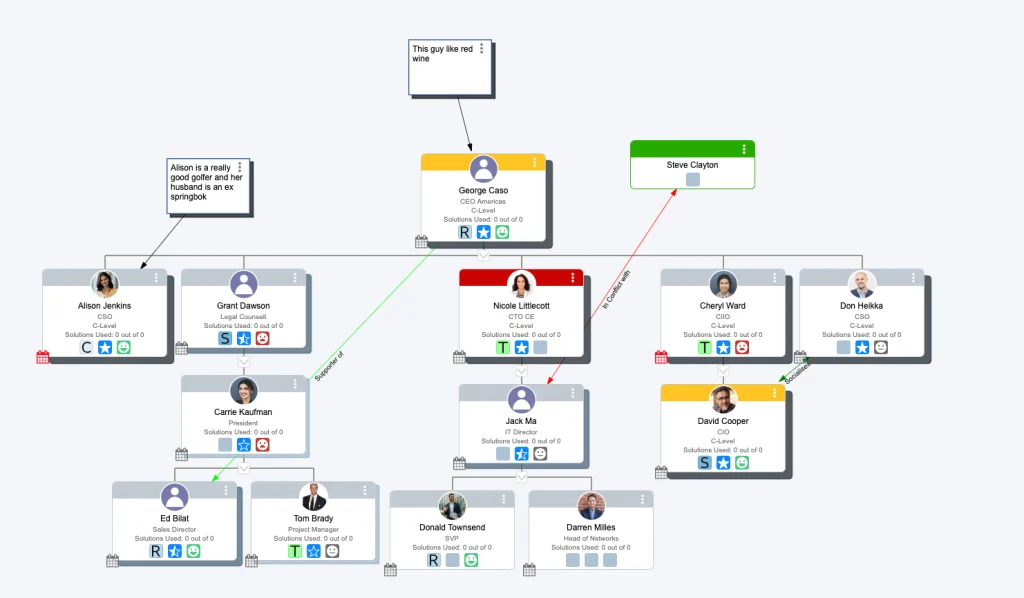
That’s why the future of sales intelligence isn’t all about faster reporting or smarter prediction. It’s creating systems that preserve and encourage human understanding regardless of turnover, so teams don’t keep relearning what they once knew. A native Salesforce tool like OrgChartPlus encourages those human insights to be recorded, and gives them somewhere to live. Somewhere visible, transferable, and cumulative.
In a sales environment where data is pretty much endless, what’s actually rare is shared context. Two people seeing the same information and understanding it the same way. That’s what keeps intelligence human, it’s not the facts we hold that matter, but how we interpret them together.
The Sales Intelligence We Keep
Artificial intelligence will keep getting sharper. It will listen, summarise, and predict with more fluency than any salesperson could manage alone. But the future of selling won’t be decided by who has the most data, it willl be decided by who understands what the data means. Because meaning cannot be decided by AI.
The question now is what you do about it.
Embrace AI for mechanical work, not strategic thinking. Let machines handle transcription, data entry, and pattern detection. Use AI-generated call summaries as evidence and reference material. Let it flag anomalies in buyer behaviour or pipeline health. These are tasks where speed and consistency matter more than nuance. But keep the interpretation human. When AI surfaces a risk, it’s your job to understand why it matters and what to do about it.
Reject automation that replaces judgment. Not every AI recommendation improves your process. Be sceptical of tools that claim to “predict” deal outcomes without understanding your buyers’ political landscape. Push back against scoring systems that reduce complex relationships to a single number. The moment you stop questioning what the machine tells you is the moment your instincts start to atrophy. Use AI as input, never as instruction.
Build systems that capture what humans know. The biggest threat isn’t bad data, it’s invisible data, the insights locked in someone’s head that disappear when they leave. Use collaborative tools that make it easy to document the human layer: who influences whom, what changed the dynamic, why this deal stalled. Tools like OrgChartPlus and Plan2Close make relational intelligence visible, transferable, and cumulative across your entire team.
Make a decision about which kind of sales organisation you want to build. One that optimises for short-term efficiency gains while slowly losing the ability to navigate complexity. Or one that uses technology to scale the very capabilities that make great salespeople great. The gap between these two paths grows wider every quarter.
Summary
Every great seller uses an accumulation of the intelligence they gather over years; every great organisation learns to protect it. The companies that win will be the ones that treat intelligence as something to be kept, not just computed.
That’s what OrgChartPlus ultimately defends: the human layer of selling. The connections, intuitions, and histories that make judgment possible. When technology amplifies memory instead of replacing it, you’ll win more deals, faster.
If you’d like to learn more about OrgChartPlus, let’s talk!