


If you’re leading a sales or revenue team, you’ve probably sat through a deal review where half the time was spent chasing basic facts, spending meetings clarifying rather than strategizing, and ending each call without real visibility into important deals.
It can feel like you’re running blind, and it’s tempting to blame your team. But we don’t think the problem is people, we think it’s the system they’re stuck working in.
Here’s why, and how, to finally fix it.
The Everyday Chase
You’re twenty minutes into your Monday morning pipeline meeting, your coffee’s gone cold and you’re already feeling that familiar pang of frustration creeping in. You ask a straightforward question, nothing tricky:
“So…what’s the actual plan to close this deal?”
Silence. A few people glance around. Eventually, your most experienced rep speaks up:
“I think we’re waiting to hear back from them.. Jess mentioned sending over a proposal, but I’m not sure if they’ve reviewed it yet.”
You nod, sigh inwardly, and ask another question:
“Have we heard back from their legal team yet?”
This time it’s quicker, but not clearer:
“Last I saw, legal was looped in. Mike said he sent an email on Friday. Haven’t seen an update. Should I ping him now?”
Multiply that uncertainty across 10 account managers and 150 strategic accounts. Suddenly, what should’ve been a sharp, clear meeting has become an hour-long slog. Worse, you leave without any more clarity than when you started.
You’re still chasing basics rather than coaching and shaping strategy.
This is more than irritating, it impacts your ability to do your job well. Because while you’re chasing answers, deals aren’t being closed. You feel visibility slipping through your fingers, replaced by a nagging anxiety:
If you don’t even have clarity here, how can we confidently move forward anywhere?
The Problem Is The System
Here’s the uncomfortable truth you probably already suspect but rarely say out loud: your account managers actually know most of the answers you’re chasing. They’re not lazy or careless. In fact, most of the time they’re working harder than you realize, constantly gathering, clarifying, and juggling critical deal details.
But that knowledge rarely lives in one place. Instead, it’s scattered across a wild mess of Slack channels, email threads, random PowerPoint decks from last quarter’s QBR, and maybe worst of all, the frail human memory of whoever currently holds the account.
You don’t lose visibility because your team are being lazy, you lose visibility because your information system isn’t really a system at all, it’s chaotic but cleverly disguised as productivity.
And when a salesperson moves on or shifts roles? All that careful, painstakingly gathered knowledge evaporates instantly. You’ve seen it happen. One resignation, one internal transfer, and suddenly you’re back to zero and rebuilding visibility from scratch, chasing threads through outdated documents and ancient email chains.
Like we said, this is a structural problem. Your account managers are fighting the current, forced to operate within a system that demands precision yet offers no structure to support it.
If visibility feels impossible, that is why.
Five Questions To Ask Your Account Managers
As a sales leader, you’ve probably asked these questions a thousand times and each time, you’ve wondered why the answers weren’t already in front of you.
The irony is, every one of these questions should already have a clear, instantly accessible answer.
1. “Who’s actually influencing the close?”
The trap: Titles rarely tell the full story. A “key contact” on paper might have checked out months ago, leaving an influencer quietly calling the shots.
The clarity you need: Not just titles, but explicit evidence of who’s actively engaging, and making the decisions right now.
2. “What’s our next move, and when?”
The trap: Vague answers like “soon,” “next week,” or “we’re working on it” sabotage clarity and momentum.
The clarity you need: Clear actions with specific dates. Ambiguity kills momentum; dates fuel accountability.
3. “What’s blocking progress?”
The trap: Without structured clarity, blockers become excuses, reasons pile up, and weeks disappear.
The clarity you need: Specific, evidence-backed issues flagged openly, not whispered privately or hidden in Slack threads.
4. “When did we last engage someone senior?”
The trap: If you’re guessing, it’s probably been too long. Good relationships rarely stall silently. They deteriorate slowly, unnoticed until it’s too late.
The clarity you need: Instantly visible timelines. Who spoke with whom, exactly when, and about what.
5. “What’s changed since last month?”
The trap: The most dangerous shifts in accounts aren’t dramatic, they’re subtle and easily missed. Without clear tracking, you won’t notice the ground shifting beneath your feet until you’re off balance.
The clarity you need: Regularly updated, structured insights clearly showing meaningful shifts and risks..
You don’t need to keep asking these questions over and over again. You just need a better way to surface the answers consistently. And that’s exactly what Plan2Close is designed to do, making answers instantly accessible inside Salesforce, visible anytime you need them, without the chase.
Coaching
Good sales coaching has nothing to do with inspiration posters, vague encouragement, or a series of cryptic, rapid-fire Slack questions. It’s not a weekly guessing game where salespeople brace for a grilling and managers desperately try to piece together the state of an account from partial clues.
Good coaching, at its heart, is about clarity, about being able to see exactly what’s happening in every deal without chasing down scattered information or relying on hazy memory. You can’t truly help someone improve if you’re working from fragments.
You need the full, honest picture.
With Plan2Close, every deal follows a clear structure defined by you, or you can bring in a sales methodology. Not your team, not intuition, and definitely not chance. Your coaching conversations become precise because they’re rooted in evidence rather than guesses. There’s nothing vague about a well-defined system. It doesn’t just surface good news; it exposes blockers, hesitations, and gaps immediately, exactly the moments when good coaching actually matters.
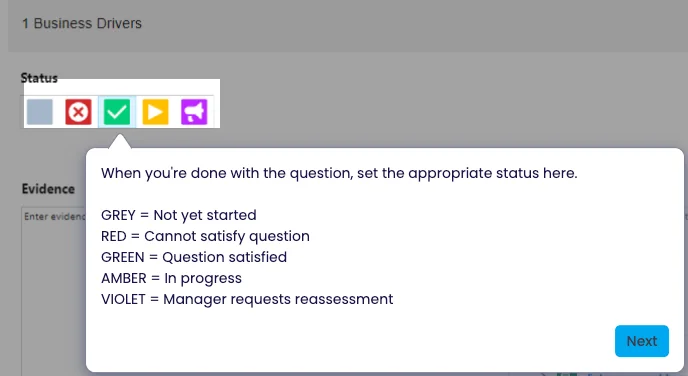
And if something doesn’t add up? You don’t have to dance around it. Just hit the Violet Challenge button. It’s a simple way to flag issues or question the evidence, and kicks off a proper conversation. We’ve added an image below. You don’t even need to leave Salesforce.
Think of it this way: you log into Salesforce, and the narrative is already waiting. Each account manager’s thinking is clearly captured and logically structured. No decoding or surprises. Just instant clarity about what’s working, what’s stuck, and precisely how you can help.
That’s not micromanagement, it’s genuine support.
When visibility is embedded into your workflow, your conversations shift from awkward interrogations to genuine discussions about strategy, and deal closure. You’re no longer hunting for information. Instead, you’re both looking directly at it, working together to close more deals, faster.
The best part is your team starts seeing coaching as helpful, not stressful because you’re finally able to guide them based on reality, not assumptions.
The Value
Your next pipeline review meeting won’t have the familiar anxiety, hesitation, and vague assurances. No more awkward silences, frantic Slack pings, or endless digging through scattered notes. Instead, you ask a question and get the answer (or you already know it), immediately clear, credible, and backed by real evidence.
Your meetings suddenly become meaningful conversations rather than desperate attempts at information retrieval. You and your account managers are aligned because you’re looking at the same crystal-clear picture: decision-makers, timelines etc. all plainly visible because it’s been captured and structured inside Salesforce.
What you’ve achieved is confidence that your team is actually working from shared truths rather than individual knowledge. It’s reassurance that when someone inevitably moves on or shifts roles, you won’t lose critical insights or relationships.
It’s the peace of mind that comes from knowing you’re finally operating from clarity.
Your job shifts back to what it should be: shaping strategy, coaching talent, and confidently steering your organization forward, no longer chasing answers that should already be at your fingertips.
That’s what genuine visibility looks like.
And with Plan2Close, it’s finally within reach.We’ve built a quick click through tour so you can see how it works – https://salesmethods.storylane.io/share/orclorex3jfi