

I can’t even count the number of times I thought I had a champion in a deal, who turned out to be, well, just a friendly contact. They attended calls, and answered emails without me having to follow up. Then, the deal would progress and there would be some resistance. I would painstakingly learn that the contact I thought was my ‘champion’ couldn’t help much.
As I mentioned in last week’s article on closing enterprise deals using Salesforce org charts, I have a habit of counting my commission before a deal even closes. So, you can imagine the disappointment!
Of every letter in the MEDDPICC® sales methodology, I believe Champion is the one most consistently misread, and the one most responsible for getting me excited about deals that didn’t have a real chance of closing!
This article is about how I fixed that. How I now identify real champions, how I develop the relationship deliberately, and how I arm them with material that lets them sell for me. And, because I also learned that even the strongest champions change roles or get poached, I’ll discuss how to protect a deal when the champion you were relying on disappears.
What are the Qualities of an Enterprise Sales Champion?
In my opinion, a champion has three non-negotiable qualities. They carry genuine, confirmed influence inside the buying group. They have access to the Economic Buyer, and they have a personal interest in your solution winning.
The trap I used to fall into is mistaking helpfulness for advocacy. A friendly contact will share information; a champion will spend political capital. By this, I mean using their personal credibility, influence, and relationships inside the business to help the deal move forward. For example, asking colleagues to attend a demo. A friendly contact will tell you who the EB is; a champion will get you in the room.
How to Find a Real Champion
There is a plethora of job titles these days, all meaning different things. Power, influence and politics do not care about a job title. So, I find it a fair assumption to say that job titles lie and official org charts flatter. When trying to establish a champion, I watch behaviour over a handful of interactions.
I believe there are four signals to look out for.
First, they begin asking my questions to their colleagues. For example, the discovery questions I asked them last week, they are now asking a peer in finance and reporting back.
Second, they introduce me to new stakeholders without being prompted, because they have started to feel that broader exposure inside their company helps the deal.
Third, they share information they ‘technically’ shouldn’t, this could be a competitor’s current standing, or the political tension between two VPs.
Fourth, and I think this one is underrated, is that they push back. A real champion will correct my misreads, tell me when a slide won’t land with their CFO, or warn me you when I’m pitching the wrong outcome. Champions that argue with me have skin in the game, they want my solution more than they want to be nice. It is a good signal that they actually care.
I’d also like to point out a mistake I commonly make when reading behaviours – early-stage enthusiasm is a signal worth following, BUT only as a candidate for potential champion – never as a conclusion.
In other words, enthusiasm by itself is not a good enough reason to designate a contact as champion.
How to Develop a Champion
I find identifying a possible candidate to become my Champion relatively straightforward, but turning that contact into an internal seller is much harder. It’s more deliberate work, and it’s easy to give up on the development phase because it can often feel like nothing is really happening.
An analogy that helps me is thinking about this sort of activity in the same way compound interest works. I’m getting interest on the previous bit of interest, so it grows faster over time.
There are three kinds of activity I focus on.
The first is making the champion look good. I’ll bring them a case study they can forward to their boss, or a stat that sharpens the business case they are already trying to make. My champions are betting their reputation on me; so I give them ammunition for the internal narrative they are already constructing.
The second is trading intelligence rather than collecting it. I learn what they prefer about a competitor, they learn how a similar-sized company in their industry are using our tools to win more business. One-sided information flow turns contacts into sources; two-sided flow turns them into partners. Forging a mutually beneficial relationship is key.

The third is having the hard conversations. I need to be able to tell my Champion something they don’t want to hear. Maybe it’s that their timeline is unrealistic, or that the stakeholder they want to avoid has to be engaged. Hopefully, they respect me more afterwards, but I must be very careful as I’m tiptoeing on the line that most vendor relationships never cross.
I think that value and cadence matter more than frequency when it comes to this activity. A thoughtful, predictable touch once a week beats a scattered burst of emails.
If you’re interested in running MEDDPICC® inside Salesforce and being able to report on it using Salesforce reports and dashboards, take a quick click through tour of our solution below:
Getting your Champion to sell for you
A champion can only sell as well as the material you provide them, and I used to hand over a corporate deck that I thought looked good. However, I realised that it was designed for my own presentation style rather than for someone that was internally advocating.
My champions needed a small kit of simple artefacts. A one-page summary written in the Economic Buyer’s language, ROI focused case study for the Finance stakeholder, references from a company the buying group would recognise etc.
This is becoming more important as the consensus problem within buying groups has become measurably worse. Gartner’s 2025 survey reported that “seventy-four percent of B2B buyer teams demonstrate unhealthy conflict during the buying decision process” and found that buying groups that reach consensus are 2.5 times more likely to report that their deal was high-quality. The champion’s job, in other words, isn’t to persuade anyone in isolation, but to reduce friction across a fragmented group. Your material needs to make that easier, and tailored ammunition does exactly that.
How to Protect Your Deal
Every seller knows the feeling of a ‘certain’ deal dying because the champion left, got promoted laterally, or had their budget moved under a new VP who didn’t know you. Champion loss is such a common killer of late-stage forecasted revenue, and it is almost always foreseeable in retrospect.
The mitigation sounds obvious and almost nobody does it properly: multi-thread from day one, regardless of champions strength. Cultivate a second credible advocate before you need one. Pay attention to the signals that a champion’s position is shifting and activate the backup relationship the moment any of those appear. Waiting for the farewell email is not good enough.
Turnover risk extends to your own side of the table too, which I explored in how to manage sales team turnover without losing revenue.
The harder truth underneath all of this is that multi-threading only works if you can see where your coverage is actually thin. Most reps discover the gap after the champion has already gone.
Understanding Your Champion using a Salesforce Org Chart Tool
Everything I have spoken about above is so difficult to achieve without genuine visibility. If all the knowledge I have on my champion lives in my head, what happens to all the work I’ve put in if I hand over the account or take annual leave? What if I leave the company? No-one else knows what I know.
Using OrgChartPlus, each contact on my stakeholder map carries attributes for opinion, influence, and intimacy, alongside the relationship lines that connect them. I use socialises, collaborates, knows, conflicts with. I also colour code based on role, department etc. All this information lives on the account or opportunity record, available to anyone with the right permissions. Most importantly, my manager.
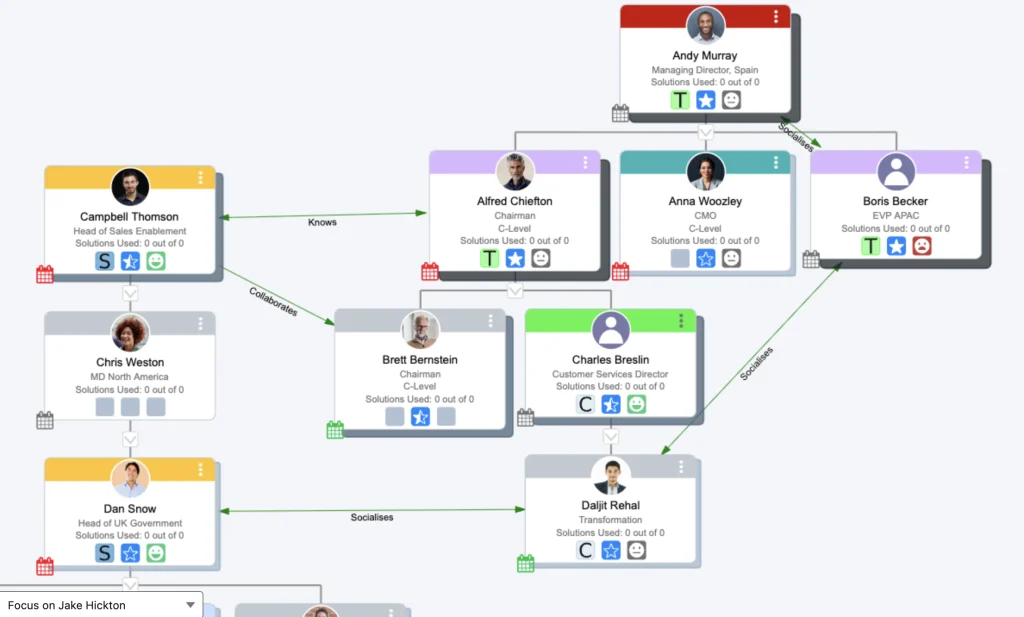
Take the account above. My Economic Buyer is Andy Murray (no, not the tennis player), who I have colour coded in red. He is the person holding the budget, and he’s signing the contract, but I haven’t had any conversations with him yet. He’s a target contact.
I can see two yellow contacts, Dan Snow and Campbell Thomson, I use this colour to identify possible champion candidates.
Dan Snow looks promising: his attributes tell me he’s a fan of our solution and I’ve had plenty of good conversations with him. But I can see he doesn’t have much influence… so I should view him a useful ally rather than an internal seller. Treating him as the primary champion would be a classic mistake that might end up in my heart breaking as this deal falls apart.
Where Dan becomes genuinely valuable is as a connector. I can see he socialises with Daljit Rehal in Transformation, who socialises with Boris Becker, EVP APAC. Chances are, the three of them have a decent relationship outside of work. It’s a fair assumption that Dan could speak to Boris on my behalf. Even if he can’t, I know he could ask Daljit to make the intro.
Boris is marked as a target contact: I can see he has a high influence on this deal, but currently low opinion, he doesn’t like us very much :(.
The easy option would be to ignore him and hope that he doesn’t have enough influence to derail my deal.
No chance, I want that commission!!
I can see that Boris socialises directly with Andy Murray, my EB. Ignoring him is not an option.
So, I know my next steps are to use my contacts to build a relationship with Boris.
I need to be careful though, because Boris might turn out to be a brick wall and not interested in our solution, or Dan could get made redundant. I know I shouldn’t just rely on Dan and Daljit to help me close this deal.
Let’s look at Campbell Thomson, the second yellow marker. Medium influence, and he likes us, we have a good relationship. Another candidate for a champion, but he might not have the direct influence I need.
There are two people on my org chart with the influence I need to get this deal closed. Boris and Alfred.
If I look closer, I can see that Campbell knows Alfred Chiefton, another target contact that reports directly to my EB. Now I know I need to leverage this relationship with Campbell to speak to Alfred and get him on my side.
So, my next steps are clear. If all goes well I’ve gone from a few friendly contacts with relatively mediocre influence to two contacts with high influence that like our solution, AND report directly to my economic buyer.
I’d be confident to chuck this deal in the forecast now, wouldn’t you?
Could you see your team winning more business if they knew all this info at a glance without having to leave Salesforce? Think about how much easier it would be to coach them.
You can test OCP in your sandbox for free and build an Org chart with your own Salesforce data using this link.
Don’t be half-hearted with your champion
The deals I now win aren’t won by being more charismatic or running better demos. They’re won by treating champion development with discipline. Identify, develop, arm, protect, and track. By making relationship strength visible enough that I, my manager, or whoever inherits the account can see exactly where the deal stands and what to do next.
A champion strategy that lives in my head isn’t a strategy.
If your team uses MEDDPICC®, Plan2Close MEDDPICC® brings it inside Salesforce and allows you to coach your team through the whole methodology and report on it. OrgChartPlus gives you the relationship visibility underneath it. Together, they turn “who’s our champion?” from a gut-feel answer in pipeline review into something you can actually demonstrate.
For any enquries, please don’t hesitate to get in touch at sales@salesmethods.com
MEDDPICC® is a registered Trademark of Darius Lahoutifard, founder of MEDDIC Academy https://MEDDIC.academy, where MEDDPICC® courses can be taken. The content of this application and service is not sponsored or validated, neither by Darius Lahoutifard nor by MEDDIC Academy.