


The Evolution of Key Account Management in Business Organisations
KAM is never implemented…. there is an ongoing, continuous and very long term commitment to continual improvement for the best practice KAM companies.”
Davies & Ryals, 2009, p1041 (1)
KAM can start small and develop over time. It is a major business change, subject to the same risks and resistance as all business change. A change management model can help to understand the process.
Kotter’s eight step model of business change (2), as applied to KAM
- URGENCY – A champion, typically the Sales Director, notices that the business environment and customer demand has changed and alerts the Board. Belief in the urgent need for change may arise from a negative event, such as the loss of an important bid. Nevertheless, many stakeholders may be complacent about the risks of doing nothing.
- VISION – The change team defines a future state which is inspiring but also logical.
- BUILDING A PROJECT TEAM – The champion seeks allies who help to analyse what change is needed and start building a business case for KAM.
- COMMUNICATION / CONSULTATION – The change team explains the need for change and the proposed solution to decision-makers and stakeholders, then listen for reactions.
- REMOVE BARRIERS – It is easier to reduce a barrier than to build up an enabler of change. The team work on reducing the barriers identified in the consultation. Common barriers to KAM implementation include lack of information, system misalignment, resistance to changes in status of accounts and people, and lack of skills.
- QUICK WINS – It is helpful to identify a promising pilot, such as a customer already keen to engage in co-creation of value and report good progress quickly.
- ACCELERATE AND CONSOLIDATE – As the pilot rolls out, the company learns from good and bad experiences.
- ANCHORING – The company determines the KAM model that is most effective and establishes it as “business as usual”.
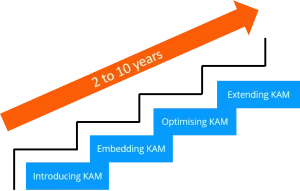
KAM can take up to ten years for full implementation (1). Typically, the emergence of a champion, the building of the business case and the recruitment and/or development of key account managers takes place in an introduction phase, as defined in the Davies & Ryals model of KAM evolution shown below. Gearing up the programme and anchoring the 7Ss of KAM comes next, which is described as the embedding phase.
A period of learning and continuous improvement follows (optimisation). Particular attention is paid in this phase to the processes and tools of KAM. Are they now fit for purpose, or do they need more work? Have new software tools become available which can help the key account teams to analyse the customer more deeply and create more insight to drive the key account plans?
As time moves on, KAM might be extended, or perhaps it might need to be reconfigured. Perhaps sector conditions have become more hostile and KAM actually needs to be scaled back. Perhaps power patterns in the supply chain have changed meaning that “specifiers” are now the key accounts. We can never assume that a KAM programme can endure in a particular form indefinitely. Over time, new champions come along with new arguments for urgent change.
Figure 1: The Evolution of KAM, adapted from Davies and Ryals 2009 (Note 1)
Most business-to-business companies in the developed world have some type of KAM programme, and many would say that they are still in the optimising phase. KAM processes and tools may need to be enhanced or adapted. This is a good time to make sure that the sales enablement system is looking ahead to incorporating the “Internet of Things” (IoT), Account-Based Marketing (ABM) and other new technology trends.
Notes:
- Davies, I. A., & Ryals, L. J. (2009). A stage model for transitioning to KAM. Journal of Marketing Management, 25(9-10), 1027-1048.
- Kotter, J.P. (1996). Leading Change, Harvard Business Press, Boston