How To Get Your Sales Team To Use MEDDPICC®
- Posted 06/2025
- Blogs
MEDDPICC® has become a popular framework for many enterprise sales teams, and for good reason. It offers a common language, while improving deal qualification and and giving managers something more reliable than instinct for their forecasts. Most leaders don’t need to be convinced of its value, they’ve already rolled it out.
But there’s a difference between a framework being known and a framework being used.
In most teams, MEDDPICC® shows up in small pockets. Salespeople reference the language in deal reviews, managers ask about Champions, and the occasional opportunity plan gets populated with the right labels. But beneath that surface, actual usage is inconsistent. Criteria are skipped and paper processes are glossed over. Fields go untouched in Salesforce, even as the team claims to be running a rigorous methodology.
We don’t think your team is unwilling, of course, closing more deals faster is beneficial for both you and them. Most teams would apply the framework if it lived where they worked. But it doesn’t. It lives in shared drives, PDFs, notebooks, and their memory. Salesforce, the place where deals are built and inspected, rarely reflects the structure the team claims to follow.
The result is a kind of illusion: leaders believe they’re coaching MEDDPICC®, and salespeople believe they’re qualifying well, yet the actual deal mechanics tell a different story, with 85% of B2B firms regularly missing their monthly sales forecast by more than 5%.
The methodology that once promised discipline becomes just another acronym on a checklist.
This article looks at why that happens, and what it takes to fix it properly. Not with more training or stricter enforcement, but by embedding the framework directly into the system of work. Because if methodology isn’t built into the environment, it’s just theory.
And theory doesn’t close deals.
Why Methodology Fails in the Wild
When methodology breaks down in a sales organisation, it doesn’t suddenly happen overnight. Salespeople don’t reject the process, they just slip back into old habits. That will always, always happen when the framework isn’t part of their daily tools.
Most sales teams are trained on MEDDPICC® in an intensive, one-off burst. Workshops are run and templates are shared. Playbooks are updated and for a time, there’s alignment. But the framework itself remains external, it’s something your team has to remember. The CRM often stays untouched and what remains is a vague expectation that salespeople will “apply the training.” This is supported by Frederico Presicci’s study that found only 25% of sales training programs connect learning to specific real-world actions.
At SalesMethods, we believe there is a structural flaw.
Salesforce, for all its ubiquity, isn’t naturally built to enforce methodology. It’s built to record, so unless MEDDPICC® is deliberately operationalised within that environment, it becomes optional. Salespeople move through deals without prompts and managers inspect pipelines without shared criteria. Over time, the gap between declared process and actual practice widens.
Another thing to note is that the signs of decline aren’t always obvious. Teams still talk about Champions while pipeline review calls still reference Decision Criteria. But the underlying work, the structured, rigorous application of those principles, becomes harder to find. Deal hygiene deteriorates quietly, often under the illusion of control.
This is not a knock on sales teams, but a simple recognition of how humans behave under pressure. When tools and frameworks aren’t embedded, they fade. Not because they’re flawed, but because they’re not present.
Within 24 hours, they have forgotten an average of 70% of new information, and within a week, it’s 90%. Some people will naturally remember more or less, but in general, the situation is appalling, and it is the dirty secret of corporate training: no matter how much you invest into training and development, nearly everything you teach to your employees will be forgotten.
We believe that strong training is important, but it’s even more important to have a blend of training and an implemented framework.
The Cost of False Adoption
As we’ve discussed, when MEDDPICC® isn’t built into the systems sales teams use daily, its application becomes inconsistent, and that inconsistency creates a misleading picture of deal quality.
In most Salesforce environments, salespeople can complete MEDDPICC® fields (if there are any) without supporting evidence or guidelines. A Champion can be marked, and the Paper Process can be flagged as ‘known’ after a single mention in a vague email. These fields become checkboxes because the system doesn’t challenge them.
That’s the risk: methodology becomes an input exercise, not a thinking exercise.
This has direct consequences:
- Deal reviews become performative. Managers scan the MEDDPICC® fields, see that they’re filled, and move on, assuming the salesperson has done the work.
- Coaching becomes misaligned. If the fields say the Economic Buyer is engaged, but the salesperson can’t articulate their priorities, coaching will focus on the wrong parts of the deal.
- Forecasts become distorted. Opportunities with weak qualifications show up in Salesforce as well-advanced. Pipeline health appears better than it is.


None of these problems show up in the moment. They show up later as missed numbers, slipped deals, and post-mortems with no clear cause. And when leaders go looking for the disconnect, the data doesn’t help because the fields were filled. The terminology was used and the methodology was, on paper, followed.
But there’s a difference between recording MEDDPICC® and applying it. Until the system can tell the difference, by guiding salespeople, flagging gaps, and enforcing logic, the organisation is managing risk it can’t see.
Bring MEDDPICC® Inside Salesforce
If the problem is structural, the fix has to be structural too. Not a mass email reminder or a stricter manager. A system that embeds methodology into the actual process of selling, at the point where deals are qualified, advanced, and reviewed.
That’s what Plan2Close was designed to do.
Built natively in Salesforce, and developed in partnership with MEDDIC Academy, P2C brings the MEDDPICC® framework into the core of sales execution.
Here’s what that looks like in practice:
- Structured yes/no questions for every MEDDPICC® pillar. Instead of filling out vague text fields, your team responds to a defined set of questions that map directly to the framework. Teams can require supporting evidence before a “Yes” is accepted, so salespeople don’t just say the Economic Buyer is engaged; they show how.
- Automatic exposure of qualification gaps. If Decision Criteria haven’t been addressed, that’s visible. If Paper Process isn’t known, the system doesn’t ignore it, it flags it. Managers aren’t guessing anymore and they can respond to trustworthy data the system enforces.
- Live plan scoring and visual deal completeness. Each opportunity carries a score, based on actual coverage across the MEDDPICC® pillars. Managers can see which areas are complete, which are weak, and whether the deal is advancing for the right reasons.
- Real-time reporting. Because Plan2Close is native, there’s no switching tools, no exporting spreadsheets, no disconnected dashboards. You can track methodology usage by team or by deal stage instantly.


This isn’t another tool your team have to remember. It’s the infrastructure they’re already using, so MEDDPICC® becomes the way every deal is worked.
Customisable To Your Deals
One of the most common hesitations we hear is this:
“Our process isn’t textbook. We’ve adapted MEDDPICC® to fit how we sell.”
Plan2Close doesn’t enforce a generic interpretation of the methodology. It adapts to how your team applies it. The questions tied to each MEDDPICC® pillar aren’t fixed, they can be easily configured to reflect the nuances of your sales motion, whether you’re selling into enterprise, mid-market, or multiple verticals.
For example:
- If your definition of a Champion includes specific influence criteria, you can build those into the yes/no logic.
- If your Paper Process varies by region or product line, you can define different requirements for each.
The structure doesn’t replace your process. It enforces it consistently, deal to deal, team to team.
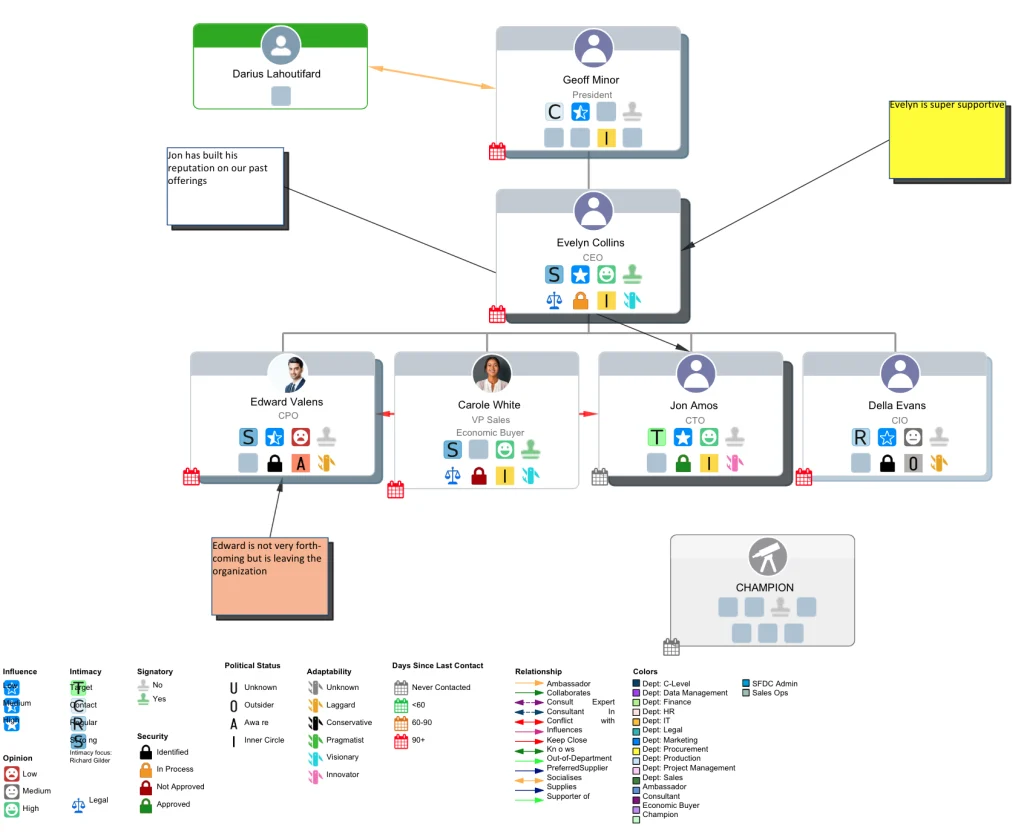
We want to make it clear that Plan2Close isn’t a MEDDPICC® tracker. It brings your version of the framework into your Salesforce org so that your team isn’t just trained on MEDDPICC®, they use it everyday.
Summary
MEDDPICC® is not just an acronym, it’s a structure for qualifying deals and forecasting with confidence. It’s a word class methodology, but application doesn’t happen through memory. It happens when the methodology is built into the system that teams already use.
If your team already knows MEDDPICC®, you don’t need to convince them to use it. You need to support them. Plan2Close makes the framework executable in every deal.
See Plan2Close MEDDPICC® in action via our quick click through tour!
MEDDPICC® is a registered Trademark of Darius Lahoutifard, founder of MEDDIC Academy™ where MEDDPICC® courses can be taken. Infinite Sales® is a registered trademark of Darius Lahoutifard.