How Salesforce Account Planning Is Changing in 2026
- By Jake Hickton
- Posted 06/2026
A while back I put together what I believed to be a genuinely good account plan inside Salesforce using Plan2Prosper. There was a clean path to expansion and I was pleased with it.
Then over the next few months my main contact got moved sideways in a restructure, and my champion was made redundant. Multiple new decision-makers arrived who’d never heard of us and didn’t much care. The account plan I had built in Salesforcde wasn’t a bad one, it just become irrelevant rapidly.
What’s actually changing with Salesforce account planning in 2026?
As I learnt, the assumptions an account plan rests on like who holds the budget, who’s championing you, who you still need to reach can all become innaccurate within a quarter.
Decision-makers are moving at a pace we haven’t seen in years. Russell Reynolds tracked 234 CEO departures globally in 2025, a 16% jump on the year before and 21% above the eight-year average: the highest in eight years. That same churn runs through the VP and director layer that makes up most of your buying group, pushed by geopolitical uncertainty and the reorganisations that follow every company’s new AI strategy.
In practice, this means the people named in your account plan might get promoted, moved, or let go faster than your account planning cycle refreshes. Do your current account plans involve contacts who have already left?
How You Could Build Account Plans in Salesforce
Take the quick click-through tour of Plan2Prosper, our native account planning tool for Salesforce.
Why Static Account Plans Expire
When a champion leaves or a new stakeholder arrives and you don’t update the plan, the whitespace opportunity still appears in a pipeline review, because it’s still attached to an account. But the people you built it on may no longer hold the budget, influence, or role they did when you mapped them, and as we’ve discussed, some may have left entirely.
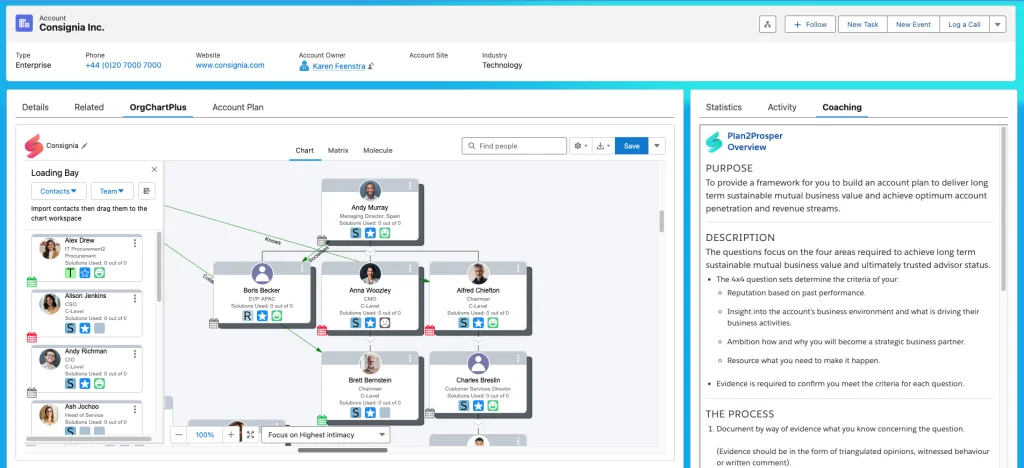
This is why account plans and stakeholder maps have to sit side by side, in Salesforce. The customer intelligence I build is worthless if it only lives in my head. I need a stakeholder view on the account record itself. I need to visualize the relationships, influence, and political lines that changes when the account changes.
That is what OrgChartPlus does for me.
Building Multi-Threaded Deals in Salesforce
The protection against this churn is coverage across the buying group. A complex B2B purchase now runs through six to ten decision-makers according to Gartner, and Forrester puts the average closer to 13 across multiple departments. Lean an account on one or two relationships and lose one, and you don’t have a plan, you have a single point of failure.
The mistake most of us make is treating multi-threading as collecting more contacts, this approach is useless unless you know which relationships carry real influence, where your coverage is thin, and which roles nobody on your team has reached. OrgChartPlus can flag every contact with no logged activity inside a window you set, so an eight-person account being worked through one relationship becomes instantly visible.
Account Planning and Org Charts Inside Salesforce
Your account plan and your org chart shouldn’t be two separate documents in different systems. They should be one system, together. Plan2Prosper holds the strategy: the goals, the whitespace, the commercial milestones, the next actions on the account. The org chart in OrgChartPlus holds the people that strategy depends on, and shows whether each one is still in role and still engaged.
Both sit on the same account record, so you stop reading them apart. The org chart shows a contact has left or gone cold; you look at the plan on the same record and see it still names that person as your champion, or as your route to the economic buyer. Salesforce account plans never look wrong on their own. You can only see mistakes if you map your stakeholders.
Final Thoughts
The change in 2026 isn’t that account pplanning got harder. It’s that you can now forecast on relationships that don’t exist, and not find out until the deal you’d banked on stalls.
If you want to see how this will work in practice, we’d be glad to walk you through Plan2Prosper and OrgChartPlus together as a complete Salesforce account planning tool.
ABOUT THE AUTHOR